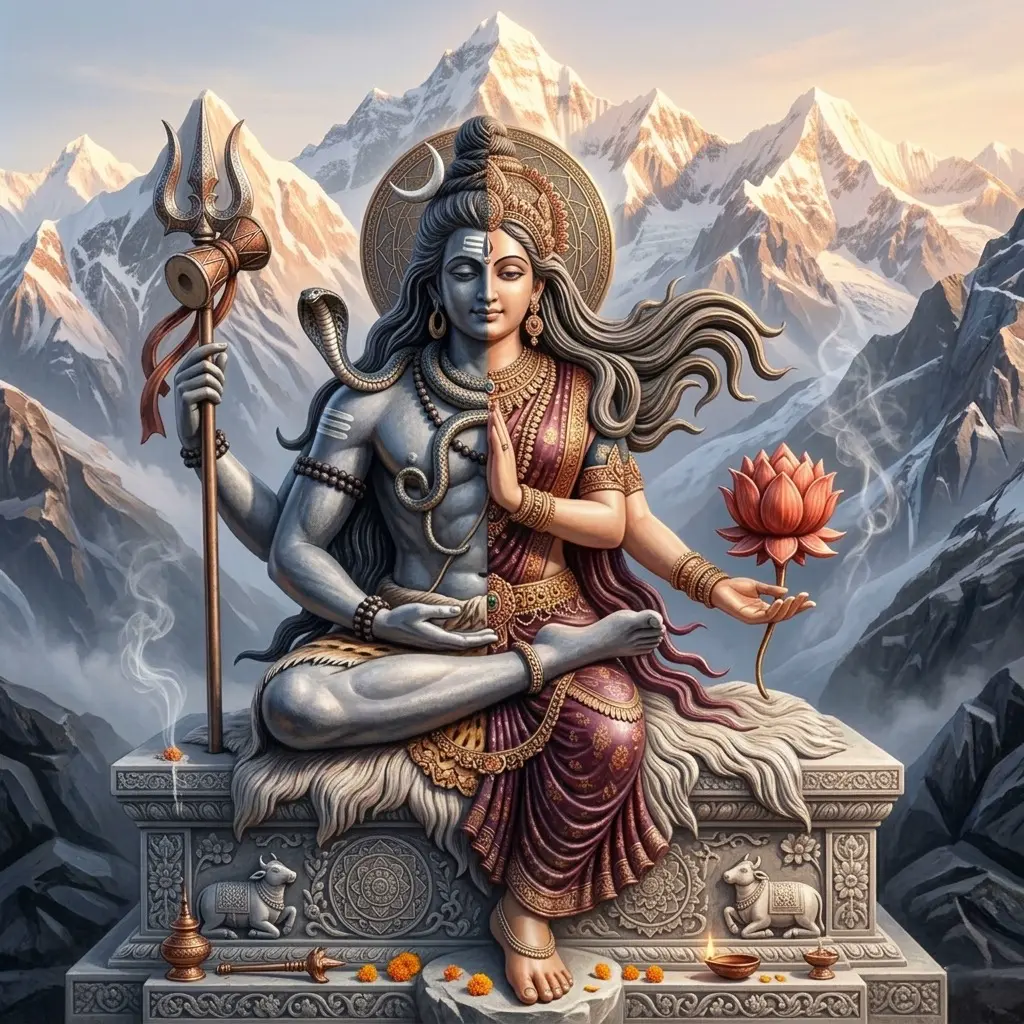
Tantra: A Complete Science of Life, Power, and Liberation
Tantra exists because human life is not made of spirit alone. Man lives in the midst of duty, hunger, fear, desire, illness, relationships, uncertainty, ambition, karma, and the longing for transcendence. Any path that ignores this fullness of life remains incomplete for most people. Tantra does not reject the world in order to reach the Divine. It addresses life as it is, and then transforms it. For this reason, Tantra offers both bhukti and mukti through the same disciplined path: worldly stability, health, protection, prosperity, clarity, and strength on one side; inner freedom and liberation on the other. It does not force a false choice between the two. This is why the Tantric tradition has remained alive across centuries. It is not merely a system of belief. It is a working spiritual technology. When practiced properly under Guru Parampara, Tantra becomes a safe, systematic, and powerful path. It first stabilizes life, then refines the mind, and finally turns the aspirant inward toward clarity, stillness, and liberation. In the present age, this is especially important. Scriptures repeatedly state that Tantra is particularly suited for Kali Yuga. In an age where attention is fractured, time is scarce, discipline is weak, and the mind is restless, prolonged Vedic rituals and severe austerities become difficult for ordinary people to sustain. Tantra works with the conditions of this yuga. It employs precise methods, shorter rituals, direct practices, mantra, yantra, nyasa, visualization, breath, and energetic alignment to produce real results. It is practical rather than abstract, experiential rather than merely philosophical. Tantra is also holistic in structure. It does not stand apart from the great streams of Indic knowledge. Rather, it incorporates and harmonizes yoga, mantra, yantra, ritual, Sankhya, astrology, Ayurveda, and allied disciplines for the benefit of humankind. Tantric practice refines the body, steadies prana, sharpens the mind, disciplines desire, and reorganizes life around sacred order. Proper practice makes the body more resilient and agile, the mind more alert and penetrating, and the will more luminous and effective. Much of what passes as “Tantra” today is either sensationalism or ignorance dressed in exotic language. Authentic Tantra is neither indulgence nor theatrical occultism. It is not a playground for fantasy, nor a shortcut for the undisciplined. True Tantra is scripture-based, ethical, exact, and initiated. It requires method, restraint, reverence, correct transmission, and proper application. Fear-mongering on one side and reckless romanticism on the other have both hidden its real nature. In ancient Bharat, Tantra and allied vidyas were never understood as something limited to extreme ritualism or secret power alone. Our epics themselves show that there are vidyas for every walk of life. In the Mahabharata, we often remember the great astras such as Brahmastra, Narayanastra, and Pashupatastra, but that is only one dimension. The tradition also preserves vidyas for skill, mastery, vocation, and excellence in worldly life. Nakula learned Ashwa-hridaya Vidya, by which he became not only an exceptional horseman but also a master charioteer, so skilled that he was said to be able to maneuver a horse even between falling raindrops. King Nala learned Aksha-hridaya Vidya, which gave him mastery over gambling. Bhima learned the vidya corresponding to cooking. In the Ramayana, Rama and Lakshmana learned Bala and Atibala Vidyas, which reduce the dependence of the human body on sleep and food. These examples reveal a larger principle: the sacred traditions of Bharat did not confine knowledge to war and worship alone. They recognized that there are subtle sciences for every field of human life. If one studies the Puranas carefully, one finds countless vidyas mentioned throughout them, enough to make a person extraordinary in almost any chosen path. When approached with faith, respect, discipline, and sustained practice, these vidyas awaken an inherent aptitude in the seeker. One does not merely “learn” externally; one becomes inwardly aligned with the intelligence governing that field. There are also specific vidyas meant for immediate and practical situations: for marriage, for sudden financial need, for protection from impending danger, and for the removal of particular obstacles. Tantra is therefore not divorced from life’s urgencies. It recognizes that the householder too needs grace that is usable, timely, and effective. This is precisely why Tantra is so relevant in the modern world. Today there is threat everywhere, uncertainty everywhere, distraction everywhere, and very little direction. People are psychologically exhausted, spiritually scattered, and materially vulnerable. In such a time, one does not need vague consolation. One needs a disciplined path that restores order, protection, clarity, and inner force. Tantra answers this need because it works directly with the realities of mind, prana, fear, desire, and karma. It does not demand that human tendencies be violently suppressed. It channels, disciplines, and refines them. Yet this practicality must not be confused with recklessness. One of the great errors of the present age is that everyone wishes to run straight toward the Dasa Mahavidyas without preparation. But these are not mild devotional forms to be approached casually. They are vast, raw, and fundamental powers of nature. To engage them properly, one must possess spiritual maturity, bodily vigor, steadiness of mind, and the capacity to hold intense energies without distortion. To borrow an analogy, Dasa Mahavidyas are like doctoral work in nuclear science, while the average person, spiritually speaking, has not yet completed primary schooling. Therefore, the mature application of Tantra is step by step progression. One must move from foundational vidyas to subtler and more demanding currents. The ocean of Tantra is vast, and wisdom lies in entering it with preparation, not vanity. Another essential principle of Tantra is that time and place matter. Tantric ritual is deeply sensitive to cosmic rhythm. The grace received from a practice may be multiplied or diminished depending on where it is done, when it is done, and under what energetic conditions it is undertaken. Different deities, who are not mere symbolic figures but concentrated forces of nature, manifest with different intensities according to time and place. Certain moments in the cosmic order become especially charged. Among such windows, eclipses hold unique importance. Regardless of one’s particular deity orientation, eclipses are widely regarded as highly conducive for the japa of rajasic and tamasic mantras. A purashcharana undertaken during such periods is said to yield the fruit of a much longer discipline, even comparable to completing a full purashcharana under ordinary conditions. This illustrates how Tantra is not random ritual, but sacred precision. Tantra is as huge as an ocean. The more one enters it, the more one realizes its depth, subtlety, and range. There are vidyas that support worldly excellence, vidyas that provide protection and stability, and vidyas that prepare the aspirant for higher spiritual attainment. This is why Tantra should be approached with maturity, not with haste or fantasy. The breadth of Tantra can also be understood through its relevance to modern life. The tradition recognizes that specific streams of sadhana harmonize with specific fields of excellence. For example: Academics, logic, and creative writing align with Saraswati Sadhana. Medicine, healing, and life sciences align with Dhanvantari Sadhana. Engineering, architecture, and craftsmanship align with Vishwakarma Sadhana. Leadership, administration, and politics align with Surya Upasana. Commerce, finance, and management align with Lakshmi, Kubera, and Yaksha-related sadhanas. Martial arts, strategy, and protection align with Hanuman or Bagala sadhana. Environmental sensitivity and hidden knowledge align with Naga Sadhana. Performance arts, beauty, fashion, and influence align with Kinnara-related vidyas. Athletics and martial excellence align with Kimpurusha-related vidyas. Scientists, occult researchers, advanced investigators, and even pilots may be linked with Vidyadhara-related currents. These are not to be understood in a shallow, decorative way, but as indications that the sacred sciences of Bharat recognized correspondences between divine intelligence and human vocation. Likewise, every sincere aspirant can be guided toward the vidya appropriate to his or her dharma, temperament, profession, and spiritual capacity. Whether the need is to protect oneself and one’s family, to gain stability, to increase one’s standing in society, to excel in one’s field, to remove obstacles, or to turn inward toward the highest truth, Tantra has something to offer. It can discipline the body, sharpen the intellect, strengthen the will, refine perception, and awaken dormant capacities. It can take a person to heights he never thought possible and open doors to dimensions of life he never imagined existed. Tantra is, truly, as vast as an ocean. But it is not an ocean meant to drown the seeker. Under right guidance, it becomes an ocean that carries him. It teaches not escape from life, but mastery within life; not denial of the world, but correct relationship with it; not power for vanity, but power yoked to dharma; not restless craving for experiences, but gradual ripening into steadiness, clarity, grace, and liberation. That is why Tantra endures. It speaks to the whole human being. And in an age such as ours, it is not merely relevant. It is necessary.